How to Hand AI the Work That Drains You
Without handing over the work that makes you valuable.
You know how to do your job.
You have the experience, judgment, and taste to produce work other people can't. The problem is how little of your week actually goes to that work.
You pull the same numbers from four different systems every Friday. You answer questions that have already been answered, clean up documents that follow the same pattern, and sit through another round of administrative work that somehow requires your name, but none of your talent.
The part of you that got you hired gets whatever is left. And most days, that isn't much.
AI Was Supposed to Fix This
In theory, this is the best time in history to be good at what you do. AI can research, analyze, draft, summarize, organize, calculate, and execute work in minutes that once took hours.
You no longer need an engineering team to automate a repetitive process. You don't need to learn to code. You don't need to buy thousands of dollars' worth of software.
And you've probably tried some of them. You watched the videos. Opened the accounts. Wrote the prompts. Maybe you even built a few automations and clawed back several hours.
Then something strange happened. The hours filled up again.
The same busywork returned in a slightly different form. The automation broke. The process changed. The tool released an update. Or the empty space on your plate was immediately filled with more of the same work.
Saving Time Was Never the Real Win
Every AI expert on the internet is promising to save you time. But saving time at the task level doesn't change what your job demands from you. It simply empties the plate so somebody, or something, can fill it again.
That's why a few clever prompts won't transform your work. It's why collecting new AI tools won't raise your ceiling. And it's why another video showing you how to automate one isolated task might help for an afternoon without changing anything that matters.
The real opportunity isn't to do the same work a little faster. It's to change the shape of your work.
To take the repetitive, draining work that shouldn't need you and build a dependable system for handling it. Not once. Not until the next update. Not until the first messy week breaks it. Permanently.
That's how the talented part of you finally gets your day.
The Tools Aren't the Solution
Every new model release makes yesterday's tutorials a little less useful. Every interface change sends you hunting for the button that used to be there. If your advantage depends on knowing one tool better than everyone else, that advantage is always approaching its expiration date.
So instead of asking what will change, ask a better question: what will stay the same?
Models. Interfaces. Pricing. Tutorials. The button that moved. The tool you finally learned last quarter. Every advantage built on a single tool has an expiration date printed on it.
Your work will still contain constraints. Some tasks will still require your judgment. Others will still be repetitive, predictable, and safe to hand off. Systems will still need to be built carefully, tested in the real world, and maintained after they launch.
Mindset. Method. Machine.
Becoming AI Native teaches a three-part approach to transforming your work: how to think, how to decide, and how to build. In that order. On purpose.
How to Think
Most people see their job as a list of things they do. AI-native people see it as a list of things that need to get done. You stop assuming every task with your name on it requires your hands.
How to Decide
Not everything should be automated, and the loudest task is rarely the right place to begin. Identify the constraint actually limiting your output, then decide what to eliminate, what to hand off, and what must remain yours.
How to Build
Big, complicated systems break in big, complicated ways. So you build in small, safe pieces, test each one against a real week, and roll it out slowly, so failures stay small enough to repair.
People Thought I Was Three Different Men
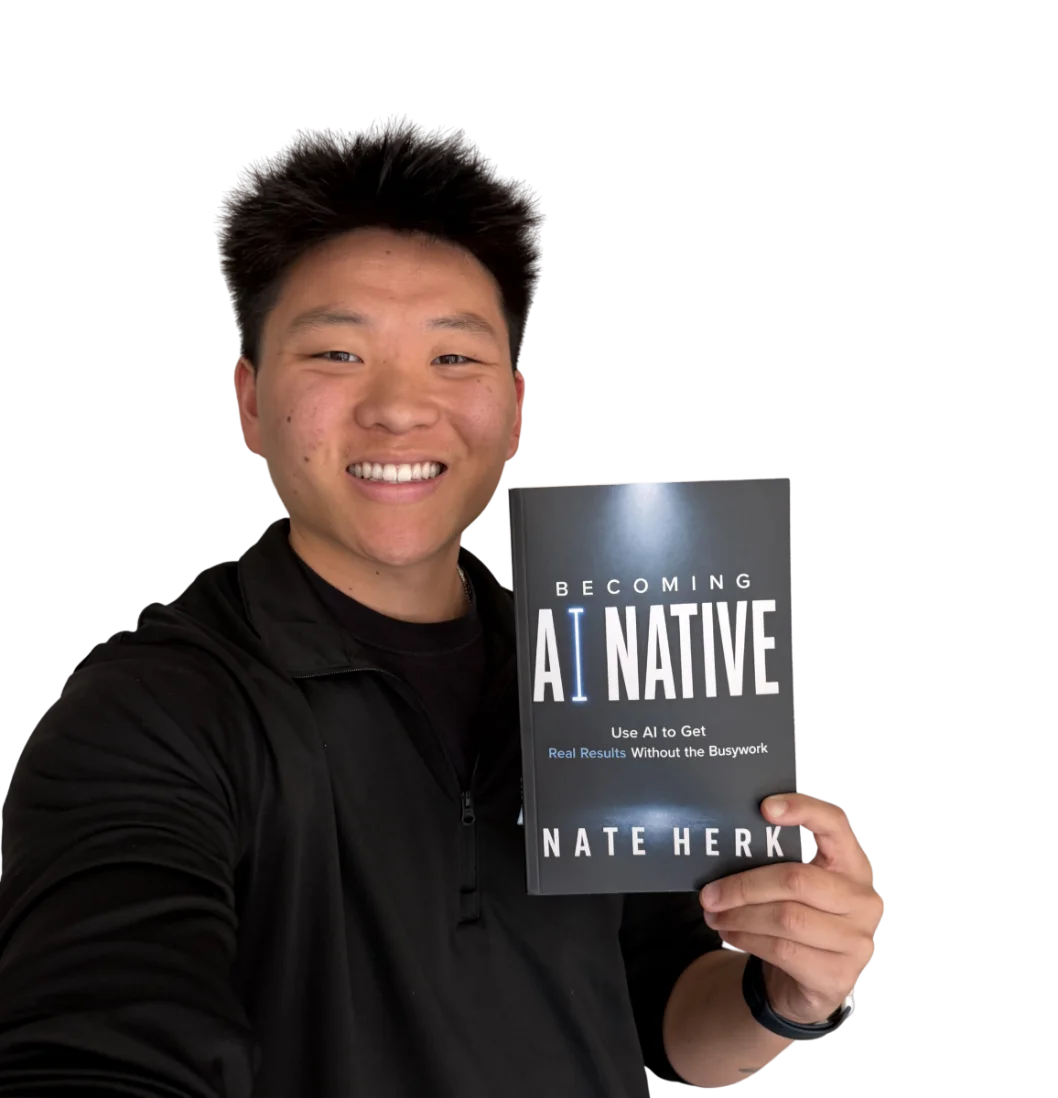
My name is Nate. When I began applying this system to my own work, my output became so difficult to explain that members of my community developed a theory. They decided "Nate" must actually be three people working rotating eight-hour shifts.
But there weren't three of me. There was one person supported by systems that kept producing after I stepped away.
Then life put those systems through a test no productivity experiment could simulate. At 22, only two months after quitting my job, I spent a week in the hospital and was diagnosed with type 1 diabetes.
My output didn't collapse. The systems kept working.
A time-saving trick helps while conditions are perfect. A real system keeps producing when they aren't.
But Output Is Only Half the Story
Before I built those systems, I knew what it felt like to contribute enormous effort and remain invisible. I built a system at work, then presented the result for an hour with my name displayed beneath my face.
After the presentation, a manager thanked me by saying:
I had created the system. I had presented it. My name had been visible the entire time. And I was still invisible.
That is what grunt work does. It consumes your ability without displaying it. You can be intelligent, hardworking, and extraordinarily capable and still spend so much time servicing the machinery around your job that nobody sees what makes you valuable. Worse, you may stop seeing it yourself.
That's why I didn't write Becoming AI Native to help you squeeze more tasks into your week. I wrote it to help you protect the work that should belong to you. Your judgment. Your ideas. Your decisions. Your taste. The thing nobody else on the team can do quite the way you do it.
AI gets the grunt. You keep the talent.
And This Time, the Grunt Work Stays Off
I once helped automate a colleague's work and gave them real hours back. It worked. Their plate emptied. Then the company promptly filled it with more of the same work.
That experience exposed the flaw in nearly every time-saving promise: if you only remove tasks, you haven't changed the system that created them.
So the book goes further. I'll teach you to cut work that shouldn't exist before automating what should, aim at the constraint limiting your output rather than whatever task happens to be irritating you today, and maintain what you build so it survives as your tools, responsibilities, and working environment change.
You aren't clearing a queue. You're changing the shape of your job so the queue stops refilling.
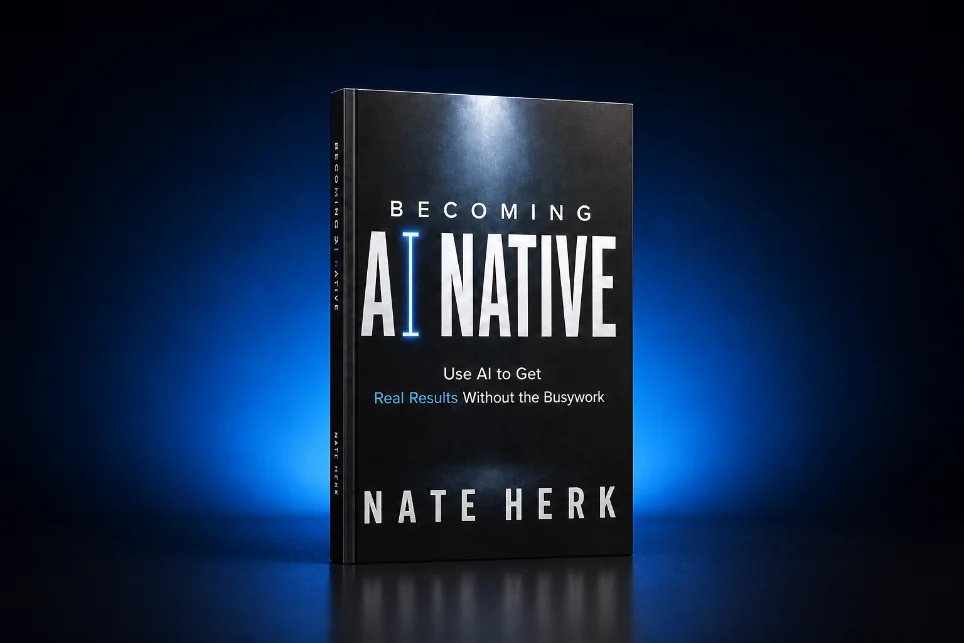
Introducing Becoming AI Native
Use AI to cut the busywork, multiply your output, and build systems that pay for themselves.
This isn't a catalog of AI tools. It isn't a book about writing increasingly elaborate prompts. And it isn't a prediction about what artificial intelligence will mean for humanity.
It's an operator's guide to getting real work done.
You'll receive a digital copy in multiple formats: PDF, EPUB, and a Kindle-compatible edition, so you can read it on the device you already use.
GET THE BOOK AND BOTH BONUSES FOR $4.99Here's What You'll Discover Inside
Why does AI seem to work for everyone but you?
The real reason your earlier attempts stalled, and why it has nothing to do with your technical ability.
Which parts of your job should never have required you?
How to spot the repetitive work hiding in plain sight.
Why can automating the easiest task be a costly mistake?
Find the constraint that is actually limiting your output before you build anything.
What should you hand to AI, eliminate, or keep?
A practical filter for making the decision without risking the work that depends on your judgment.
Why do impressive AI systems collapse during the first messy week?
How to build in small, safe pieces so failures stay small and fixable.
What do you do when an automation works 80 percent of the time?
How to cross the gap between a clever demo and a dependable system.
How do you stop one automation from creating 50 new problems?
Build safeguards before your system sends, publishes, or changes something you never intended.
How can you tell whether an AI system is worth building?
Simple payback arithmetic to compare the cost against the time or income it can return.
This Is for Anyone Who Is...
Tired of rebuilding the same reports, presentations, emails, and documents while the work that requires your actual talent waits until "later."
Ready to produce at a level that makes people wonder whether you secretly have a team.
Frustrated that every AI experiment seems to create another tool to manage, another process to repair, or another task to add to your list.
Looking for a clear way to decide what AI should handle, and what should remain firmly in your hands.
Watching other people build with AI while telling yourself you'll get around to it as soon as work settles down.
Determined to build systems that survive contact with a real week instead of collapsing the first time something changes.
You do not need to be technical. There is no code required to use the book. I've taught these ideas to people who were certain they'd never understand AI, from business owners and professionals to construction workers, Uber drivers, and single parents.
You don't need an engineering background. You need a better way to see the work.
What Readers Are Saying
"An actual filter for deciding what's worth automating and what's not."
"Critical read on driving real results with AI."
"Highly motivating."
Order Now and Get Two Complete Training Programs
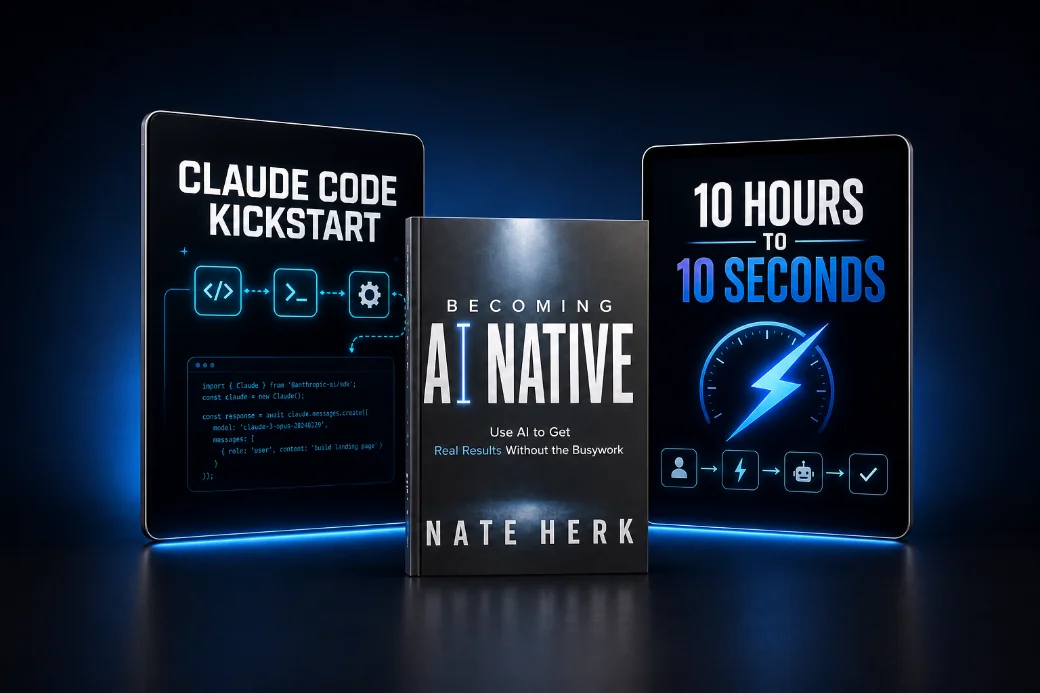
The book teaches you how to think, decide, and build like an AI-native operator. But I don't want to leave you with theory alone, so this promotion includes two practical programs that put the Method and Machine into action.
Claude Code Kickstart
Claude Code can build, modify, and debug real automations when you describe what you want in plain English. The hard part is getting it installed and working. Most tutorials assume you already understand terminals, APIs, and MCP servers.
- Install and configure Claude Code without piecing together a dozen tutorials
- Connect Claude Code directly to n8n so it can work on real automations
- Build a Gmail Tech Support Agent through conversation, not manual node-dragging
- Improve, debug, and add error handling in ordinary language
- Reuse a repeatable Vibe Coding Framework on your next build
You receive the training recordings and supporting materials. Some exercises require your own Claude subscription and an n8n instance, which are not included.
10 Hours to 10 Seconds V2
Knowing how to build an automation is useful. Knowing which automation is worth building is what separates $50-an-hour technicians from people who lead $5,000+ engagements. This teaches the discovery process that comes before the build.
- Scan your inbox, calendar, and daily work for tasks you've stopped noticing
- Identify processes that are time-consuming, error-prone, and worth automating
- Find the constraint creating the greatest drag on your output
- Compare opportunities by time saved and income produced
- Map triggers, data, decisions, and outputs before opening a tool
- Turn it into an Opportunity Map for yourself or a client
The goal is not to automate everything. It's to find the few opportunities capable of making the biggest difference, then build those first.
Your Purchase Is Protected
Open the book. Explore the training. If it isn't right for you within seven days of purchase, request a refund and we'll return your purchase price.
This is a one-time purchase. There are no shipping charges, and buying the package does not enroll you in a recurring subscription. After purchase you may be shown an optional offer to join my paid community. The book and both bonuses are complete on their own. The promotional price will not be available indefinitely; when the promotion ends, the book returns to its standard $19.99 price and the two bonus programs may no longer be included.
You Don't Need More Information
You probably already have more AI information than you can use. More videos won't solve the problem. More tools won't solve it either.
The next step is learning how to think about your work differently, then putting that new perspective into practice.
That's what I want to give you with Becoming AI Native. Not another list of tricks. A durable way to think, decide, and build. A way to get the grunt work off your plate without surrendering the work that makes you valuable. A way to raise your ceiling without pretending you can stretch the week indefinitely. And a way to make AI a reflex you carry into every job, project, and system you touch.
If that is the change you're looking for, get your copy now. I'll see you inside.
P.S. Becoming AI Native is $4.99 for a limited time, and your order currently includes Claude Code Kickstart and 10 Hours to 10 Seconds V2 at no extra cost. When this promotion ends, the book returns to $19.99 and the bonuses may no longer be included.